
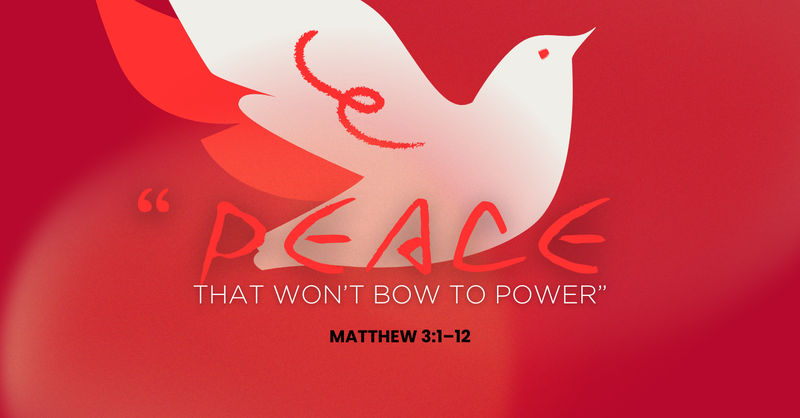
Sermon Summary
John the Baptist doesn’t launch a campaign from the temple or the Senate floor. He cries from the wilderness—the place the powerful rarely go—because truth can breathe there. That tells us something essential about how God’s peace moves: it rises from the margins, from the unheard and unseen, not from donors’ ballrooms or camera-lit podiums. So I asked us to check our loyalties and our habits. If we can give a can but won’t show up to the neighborhood, if we line up for deals but not for people, then maybe our calendars are telling on our hearts. The call is not shame; the call is turn. Repentance is a holy turn—a reorientation toward love, justice, and real neighborliness.
We don’t all vote the same way here, and we don’t need to. Unity in Christ isn’t sameness; it’s shared allegiance. John didn’t say “prepare the way of the left” or “the right,” he said, “prepare the way of the Lord.” In a season when elephants and donkeys shout for attention, we remember the Lamb. That allegiance puts flesh on our faith: it refuses the cheap peace that keeps polite silence while the poor are crushed. It insists on a peace that tells the truth, reconnects divided people, and gets practical—packing leftovers, walking into the library steps, listening before fixing, organizing instead of complaining.
I told a story about Maribel, who stood at marble steps and said, “It’s not the budget that needs balancing. It’s your priorities.” That sentence is a mirror. Repentance isn’t finger-wagging; it’s a chance to re-balance our priorities toward those Jesus calls “the least of these.” And like John’s image of the axe at the root, God isn’t out to punish, but to clear what no longer serves life. A beautiful tree without fruit cannot feed a hungry family. So we ask: are we bearing fruit that nourishes anyone beyond ourselves?
Advent peace is not fragile manners; it’s fierce, healing disruption. It won’t bow to corrupt empires or lullabies of consumer comfort. Christ comes to sift truth from spin, compassion from apathy, justice from pretense—and to give a peace the powerful cannot manufacture and the poor cannot live without. So we prepare the way by telling the truth even when our voices shake, praying with our feet, caring for the vulnerable, resisting systems that reward corruption, and building a community that refuses to be divided. The kingdom is near enough to unsettle us into love—and near enough to save.
Key Takeaways
- 1. Peace grows from the margins. God’s peace rises from places the powerful overlook, where truth is not curated for cameras but cried from the gut. If we want to find Jesus, we must go where he keeps showing up—among the unseen and uninvited. Our presence there is not charity; it’s alignment. It’s where our faith learns to breathe. [01:14]
- 2. Allegiance to the Lamb alone. Political visions are temporary; baptismal allegiance is eternal. When identity is anchored in Christ, our disagreements can sharpen love rather than fracture it. We can critique power without becoming its mirror, and act with courage without being captured by a party. The cross is our compass, not a mascot. [04:27]
- 3. Repentance is a holy turn. Repentance is not groveling; it’s re-direction—choosing a path that nourishes life and neighbors. It calls us to re-balance priorities, to ask who is unfed by our beautiful trees, and to prune what no longer serves love. The fruit of repentance is public: justice, mercy, and embodied compassion. [12:11]
- 4. Advent peace disrupts false comfort. Real peace is not quietism; it is the courage to unsettle what harms and heal what’s been ignored. It tells hard truths, crosses lines of convenience, and clears paths for God’s presence. If our peace costs the poor their dignity, it isn’t Christ’s peace. Advent refuses that bargain. [18:42]

